Choose tone from audience and relationship
Tone should describe how the reader should experience the message: direct, reassuring, technical, candid, celebratory, or restrained. “Professional” alone is underspecified. Name the audience, relationship, emotional context, and action so the model can make consistent language choices.
- Support incident: calm, accountable, specific, and non-defensive.
- Executive brief: concise, evidence-led, and explicit about uncertainty.
- Beginner lesson: encouraging, concrete, and free of unexplained jargon.
- Brand campaign: distinctive, audience-aware, and bounded by approved claims.
Set creativity according to error cost
Creativity is not a single slider. Novelty can apply to concepts, metaphors, structure, or wording while facts remain fixed. Use wider exploration for names and campaign concepts; constrain invention for policy, finance, healthcare, security, and factual summaries.
Scroll the table to review all 3 columns.
| Task | Creative range | Non-negotiable boundary |
|---|---|---|
| Idea generation | Wide | Label assumptions and avoid protected claims |
| Marketing draft | Moderate | Preserve product facts and brand rules |
| Customer support | Low to moderate | Do not invent policy or account status |
| Evidence summary | Low | Use only supplied sources and show uncertainty |
A prompt pattern for controlled variation
Specify the fixed core, the permitted variation, and the rejection criteria. For example: “Create five launch headlines. Keep the verified product claim unchanged. Vary only the framing and rhythm. Tone: confident and plainspoken, never urgent. Reject clichés, superlatives, and unsupported performance claims.”
Test tone instead of naming it once
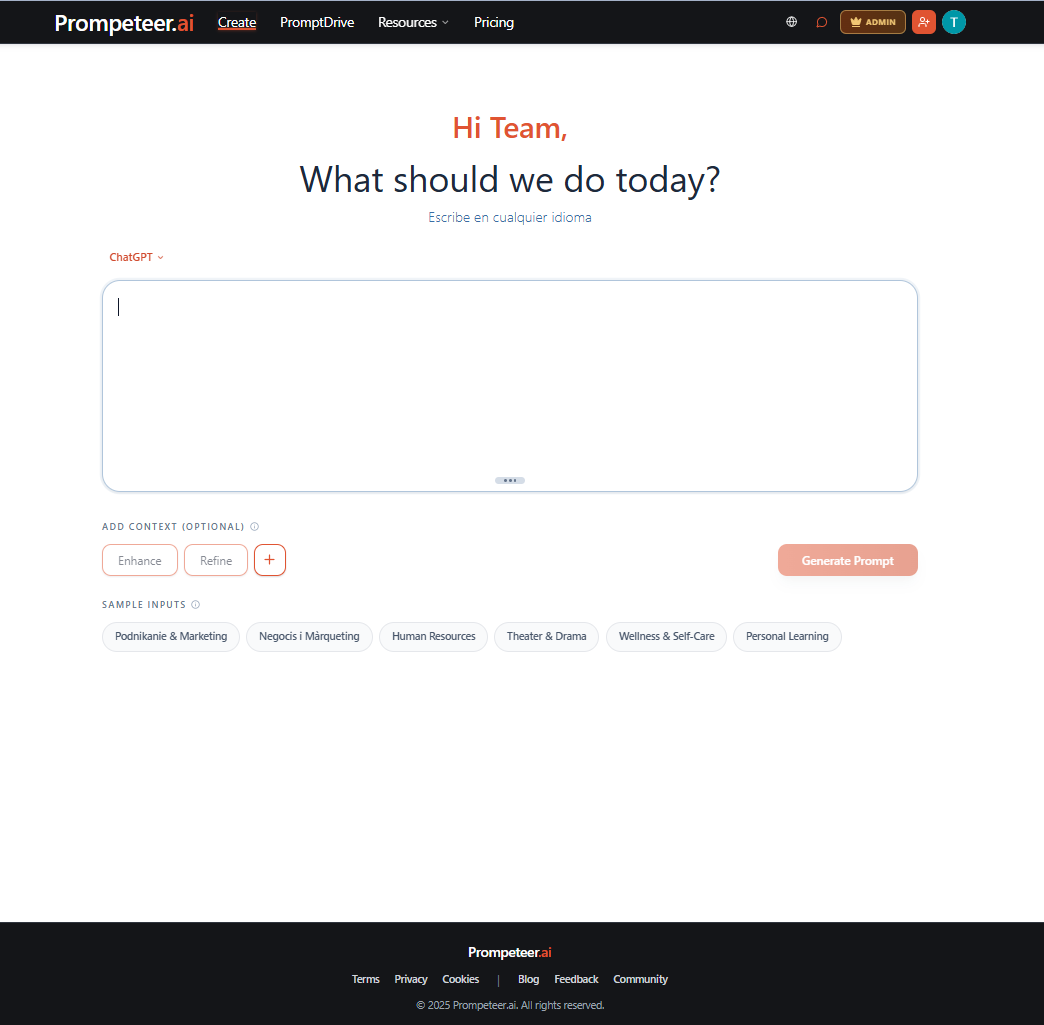
Generate a small set, explain how each option differs, and review it against real brand examples. Prompeteer can carry audience, platform, tone, and format into the prompt, use Prompt Score to expose missing specificity, and save an approved pattern for reuse.
- Include one positive and one negative example.
- Define words or claims the brand avoids.
- Check whether localized versions preserve the relationship.
- Reapprove patterns when the audience or risk changes.